Software Development Model Report
Comparative Evaluation of Waterfall vs. Agile/Iterative Lifecycles and Justification for Modern Web Redesign
Project: Efficient Overseas Study Abroad Web Modernization
Organization: Efficient Overseas (Bathinda, Punjab, India • Licence No. 1/CEA/CC-III)
Domain: Higher Education & International Immigration Consultancy
Technical Stack: Next.js 16 (App Router), React 19, TypeScript 5, CSS Modules
1. Executive Summary & Project Context
Efficient Overseas is an established immigration and overseas education consultancy operatingin Bathinda, Punjab, certified under Government of India Licence No. 1/CEA/CC-III.Established in 2005 by Rajkaran Singh Brar, the firm has guided over 10,000 students to study abroad in Canada, Australia, New Zealand, the United Kingdom, and across Europe, alongside running specialized IELTS and Spoken English training academies. The organization’s digital presence previously relied on a legacy ASP.NET application (.aspx architecture) built over a decade ago. While historically effective, the legacy platform suffered from critical modern deficiencies: absence of mobile-first responsiveness, monolithic coupling of view and server
logic, lack of dynamic lead capture validation, and poor search engine crawlability for
competitive regional queries. The objective of this project is completely full-stack modernization using Next.js 16 (App Router), React 19, TypeScript, and modular CSS while preserving legacy SEO equity. Selecting an appropriate Software Development Life Cycle (SDLC) model is critical to ensuring timely project completion, handling evolving immigration regulations, managing stakeholder reviews with educational counselors, and preventing scope divergence.
Core Objective: Evaluate the traditional Linear Sequential (Waterfall) model against Agile/Iterative methodologies to identify the optimal execution framework for delivering the modernized Efficient Overseas digital platform within academic and business constraints.
2. Linear-Sequential Model (Waterfall) Analysis
The Waterfall model prescribes a rigid, linear progression across sequential phases:
Requirements Definition, System Design, Implementation, Verification (Testing), and
Maintenance. In this paradigm, each phase must be formal sign-off before subsequent activities commence.
Strengths of the Waterfall Approach:
• Rigorous Milestone Discipline: Clear stage boundaries provide precise tracking against baseline schedules.
• Deterministic Documentation: Comprehensive initial documentation establishes an
unambiguous contractual baseline.
• Resource Allocation Stability: Technical prerequisites and design mockups are fully
finalized prior to engineering.
Critical Limitations for Efficient Overseas:
• High Vulnerability to Regulatory Shifts: Immigration policies (e.g., Canadian PGWP
updates, Australian 485 visa rule amendments) evolve dynamically. Waterfall cannot
absorb content/domain logic pivots mid-flight.
• Delayed Stakeholder Validation: Business stakeholders (counselors, MD) only inspect a working system late in testing, exposing the project to severe expectation misalignment risks.
• Late Defect Discovery: Integration issues, responsive layout breakpoints, and 301
redirect regressions are caught during late testing, compounding remediation expenses.
3. Agile / Iterative Development Model Analysis
Agile methodologies decompose software delivery into rapid, time-boxed increments (sprints) lasting typically 1 to 2 weeks. Each iteration spans planning, technical design, coding, crossbrowser verification, and stakeholder review, culminating in a working, deployable product increment.
Key Strengths for the Redesign Project:
• Progressive Feature Delivery: Core architectural foundations and the landing page are stood up first, followed sequentially by individual country hubs (Canada, Australia, NZ, UK) and service portals.
• Early and Continuous Feedback: Interactive prototypes and deployed preview URLs
allow the Managing Director and counseling staff to critique messaging, tone, and mobile usability early.
• Empirical Risk Mitigation: Complex technical challenges—such as legacy 301 redirect
preserving rules and client-side form validation—are isolated and tested in dedicated
sprints.
• Adaptive Refactoring: Architectural components (e.g., dynamic country cards, SVG
flag visualizers, FAQ accordions) are iteratively refactored for modularity and high
performance.
4. Comparative Evaluation: Waterfall vs. Agile
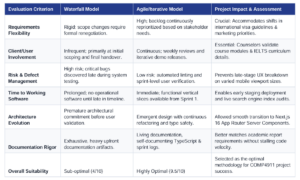
A rigorous, criteria-based evaluation was conducted across 7 core engineering and business dimensions relevant to the Efficient Overseas project:
5. Methodology Selection & Tailored Agile Lifecycle
Based on the comparative analysis, an Agile/Iterative Hybrid Lifecycle was formally chosen for the Efficient Overseas modernization project. This hybrid approach combines the structured requirements baseline of engineering projects with the rapid, feedback-driven implementation cycles of Agile.
The project development roadmap was structured into five distinct, two-week iterative sprints:
Sprint 0: Architectural Inception & Discovery: Audit legacy ASP.NET URL patterns;
establish Next.js 16 TypeScript repository; configure ESLint and CSS custom property design system tokens.
Sprint 1: Core Navigation & Homepage Experience: Implement global responsive Header, Footer, Hero section, Trust Metrics bar, and primary call-to-actions; verify Lighthouse baseline.
Sprint 2: Academic Destinations & Visa Verticals: Develop dynamic country landing pages (Canada, Australia, New Zealand, UK) with flag components, visa highlights, and educational pathways.