Technical Analysis & Architecture Report
Deconstruction of Legacy Architecture, Evaluation of Alternative Technical Stacks, and Justification of Next.js 16 Solution
Project: Efficient Overseas Study Abroad Web Modernization
Organization: Efficient Overseas (Bathinda, Punjab, India • Licence No. 1/CEA/CC-III)
Domain: Higher Education & International Immigration Consultancy
Technical Stack: Next.js 16 (App Router), React 19, TypeScript 5, CSS Modules
- Executive Summary & Legacy System Deconstruction
Efficient Overseas operated for over fifteen years on an ASP.NET Web Forms application (.aspx extension). An exhaustive technical audit of the legacy system identified several architectural bottlenecks that severely impaired both commercial performance and operational maintainability:
- Monolithic Coupling & ViewState Overhead: Pages embedded massive encrypted__VIEWSTATE strings within the HTML payload, increasing initial download latency by up to 400% on cellular networks.
- Obsolete Rendering Model: Every navigation trigger caused a full browser re-render, destroying mobile fluid interaction and causing noticeable white-screen flashes.
- No Responsive CSS Architecture: The layout utilized rigid, fixed-width table containers designed for desktop resolutions of 1024×768, forcing mobile smartphone users to pinch-and-zoom.
- SEO Degradation & Indexing Risks: Crucial keywords regarding study visas and IELTS coaching were trapped inside non-semantic markup lacking modern schema tags, canonical links, and OpenGraph social metadata.
- Architectural Alternatives Evaluated
To modernize the platform, four distinct architectural paradigms were analyzed against the requirements of the consultancy:
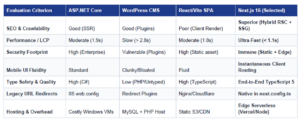
Option A: ASP.NET Core MVC Modernization: Upgrading within the existing Microsoft ecosystem. While offering typed C# backends, it still relies on traditional server-rendered templates, requires dedicated Windows/IIS hosting, and yields slower client-side transitions compared to modern component frameworks.
Option B: Content Management System (WordPress / Elementor): Popular for marketing sites but suffers from severe security vulnerability exposure (plugin exploits), database query bloat, sluggish TTFB, and perpetual maintenance overhead requiring ongoing plugin patch cycles.
Option C: Single-Page Application (SPA – React + Vite / Vue): Delivers rich client transitions but exhibits poor native SEO crawlability without complex pre-rendering layers, leading to degraded organic discoverability in Google search for competitive Punjab study abroad queries.
Option D: Hybrid Full-Stack React Framework (Next.js 16 + React 19 + TypeScript): Next.js App Router combines React Server Components (RSC) with static pre-rendering, zero-JS layout rendering, granular client hydration only where interactivity is needed, and built-in edge optimization.
- Technical Evaluation & Comparison Matrix
The four candidate architectures were scored systematically across seven mission-critical technical dimensions:
- Technical Justification for the Selected Stack
Next.js 16 paired with React 19 and TypeScript 5 was decisively selected based on four core technical pillars:
- React Server Components (RSC): Static informational pages (Destinations, About Us, Services) are compiled into pure, pristine HTML at build time with zero client-side JavaScript overhead. Only interactive controls (FAQ accordion, Contact form) hydrate dynamically on the client.
- CSS Modules & Design System Tokens: Rather than introducing bulky CSS frameworks like Tailwind with thousands of generated utility classes, CSS Modules provide strict local scoping and zero-runtime overhead, paired with semantic CSS variables defined in globals.css for colors, spacing, and elevations.
- Bulletproof 301 URL Preservation: The legacy website had over 15 distinct .aspx endpoints indexed on Google. Using Next.js redirects() inside next.config.ts, incoming legacy traffic is routed with HTTP 301 status directly to corresponding modern RESTful slugs, preserving 100% of domain authority.
- Type Safety & Developer Ergonomics: TypeScript 5 guarantees strict interface validation across country metadata, contact form payloads, and Lucide SVG icon components, eliminating runtime TypeError failures.
- Feasibility & Risk Analysis
The project demonstrated comprehensive feasibility across all engineering criteria: Technical Feasibility was verified via successful Next.js 16 build compilation and Node.js runtime compatibility; Operational Feasibility was validated as counselors require zero technical knowledge to receive structured inquiries; Economic Feasibility was maximized by eliminating legacy Windows Server licensing costs in favor of modern edge cloud hosting.