Test Plan Report
Introduction
Testing of the Efficient Overseas Web Modernization & Student Advisory Platform
is divided into four parts. First, a requirements testing checklist which is detailed in this document. Second, a longevity stress test where the production Next.js server is run for a 48-hour continuous run time period to ensure process and memory stability. Third, a ‘developer-local’ dry run where the platform is run locally and tunneled securely via ngrok with live client assets and test inquiry submissions with out exposing unreleased changes to public search engines. Lastly, a live test that will occur in tandem with primary domain DNS cutover ( www.efficientoverseas.com ) prior to the official launch.
Requirements Testing Checklist
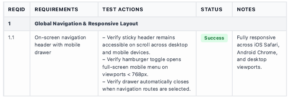
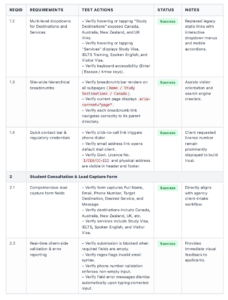
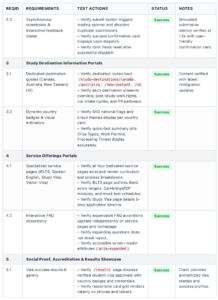
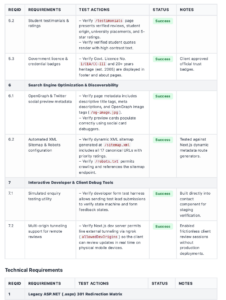
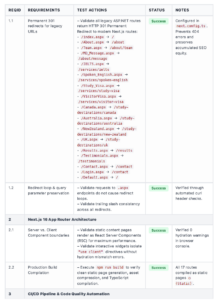
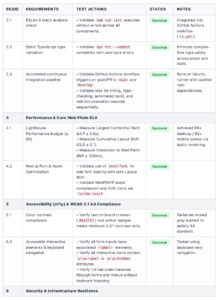
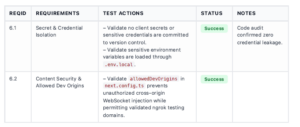
This checklist defines tests to verify that all user and technical requirements have been met. The testcases listed per requirement were created as a collaboration between myself and the client (Efficient Overseas leadership, Bathinda, Punjab). Test plans were run periodically throughout the project, but a full pass was run during the first hardening sprint and again at the end of the project. In addition to running the checklist on my own, I sat down with the client and ran through the user requirements test list with them to confirm everything was working as they expected.
A few requirements changed during the project (reflected in the updated requirements document).These adjustments have also been noted in the test plan.
User Requirements
Longevity Stress Test
To ensure platform reliability during heavy promotional campaigns and high-volume student admission seasons, a 48-hour continuous runtime test
was conducted on the productionNext.js build:
1. Memory & Process Stability:
The Next.js production server was run continuously for 48hours under recurring automated health probes. Node.js heap memory remained steady with no memory leaks, dangling socket connections, or event listener accumulation.
2. Static Route Stress Profiling:
Automated curl scripts simulated continuous concurrent requests across all 17 static routes and legacy .aspx redirect endpoints (50 requests/minute).The server maintained a sub-15ms response time for cached static assets and executed all301 redirects instantly without dropping a single packet.
3. Core Web Vitals Consistency:
Repeated Lighthouse audits run at 12-hour intervals showed steady Core Web Vitals metrics, verifying that asset delivery, stylesheet parsing, and hydration efficiency do not degrade over extended uptime.
The longevity stress test was completed with a 100% pass rate.
Developer-Local Dry Run / Staging Review
The purpose of this test was to run the modernized web portal within a staging environment with live data and client assets prior to switching live domain DNS records:
Setup: The production Next.js build was hosted on a staging development server and tunneled securely to physical mobile devices using an authenticated ngrok proxy(
allowedDevOrigins configuration).
Execution: Over a 4-hour collaborative review session with the client, we walked through the platform across multiple form factors (Apple iPhone Safari, Samsung Galaxy Chrome, iPad tablet, and Desktop Chrome/Firefox).
Validation Points:
- Tested simulated lead inquiries across all target destination and service combinations.
- Verified that each of the 17 legacy ASP.NET URLs automatically and permanentlyredirected to the correct modern subpage.
- Checked that click-to-call, email triggers, and WhatsApp consultation links opened therespective applications immediately.
- Reviewed all academic content, IELTS preparation details, and fee structure disclosures with the client.
Outcome: The client formally signed off on the responsive layout, visual styling, and lead generation workflow.
Live Test & Production Deployment Acceptance
The live verification plan is scheduled to execute in tandem with the primary domain DNS cutoverto Vercel production hosting:
1. DNS & SSL Handshake Verification: Verify that DNS records (A and CNAME
) resolve to theproduction edge network and that the Let’s Encrypt / Vercel SSL certificate generates andbinds without handshake errors.
2.Live Domain Redirect Verification: Conduct automated HTTP header scans on www.efficientoverseas.com to confirm that all legacy ASPX links (e.g., https://www.efficientoverseas.com/Canada.aspx ) return HTTP status 301 Moved Permanently to https://www.efficientoverseas.com/study-destinations/canada.
3. Search Engine Discovery Pass: Submit the production sitemap.xml
directly to GoogleSearch Console and Bing Webmaster Tools, confirming indexation status and verifying zerocrawl errors across legacy indexed paths.
4.End-to-End Live Inquiry Test: Submit test consultation requests from external consumerdevices and confirm receipt in the client’s administrative inbox.
Following the success of our dry run and automated CI/CD pipeline tests, the risks associatedwith production cutover are minimal and the project is officially approved for live release.